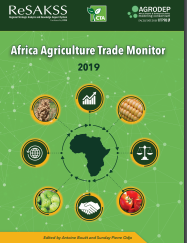
The 2019 Africa Agriculture Trade Monitor is being published at a critical moment for both international trade relations and African trade integration. At the global level, protectionist tensions are high and could have significant consequences for the world economy and for Africa in particular. Their impact is already evident in the current slowdown in the global economy. At the same time, African governments are multiplying initiatives in support of greater regional integration. The African Continental Free Trade Area is a particularly important initiative. Launched in Kigali, Rwanda, in March 2018, the agreement aims to create the largest free trade area in the world—with 1.2 billion people in 55 countries and a GDP of US$2,500 billion. In July 2019, 54 countries signed this agreement. These historic developments give this report a special significance. There is a particular need today to mobilize the most detailed statistical knowledge and technically robust tools and methods to study Africa’s trade integration and identify the most important barriers to further integration, to identify which African regional trade agreements have worked and which have failed, and to determine which sectors in Africa are most competitive and examine the characteristics of its specialization. It is also necessary to assess the possible consequences of a more protectionist global economy for Africa. Finally, clear policy recommendations are needed for current trade integration efforts on the continent. It is in this spirit that this report was designed. The report comprises six chapters, with Chapter 1 providing a general overview of the report. Chapter 2 is devoted to Africa’s trade performance in world markets, Chapter 3 focuses on measuring regional trade integration, and Chapter 4 looks at the competitiveness of African agricultural value chains. Chapter 5 focuses on the featured topic of the 2019 report, namely the potential effects on African economies of ongoing disruption to the global trading system, and Chapter 6 examines trade integration in the featured region of Eastern and Southern Africa.
PUBLISHER
ReSAKSS
Related Resources
BLOG
Ghana’s ten percent agricultural expenditure saga: Why reported... Thu, 07/18/2019
Ghana’s ten percent agricultural expenditure saga: Why reported...