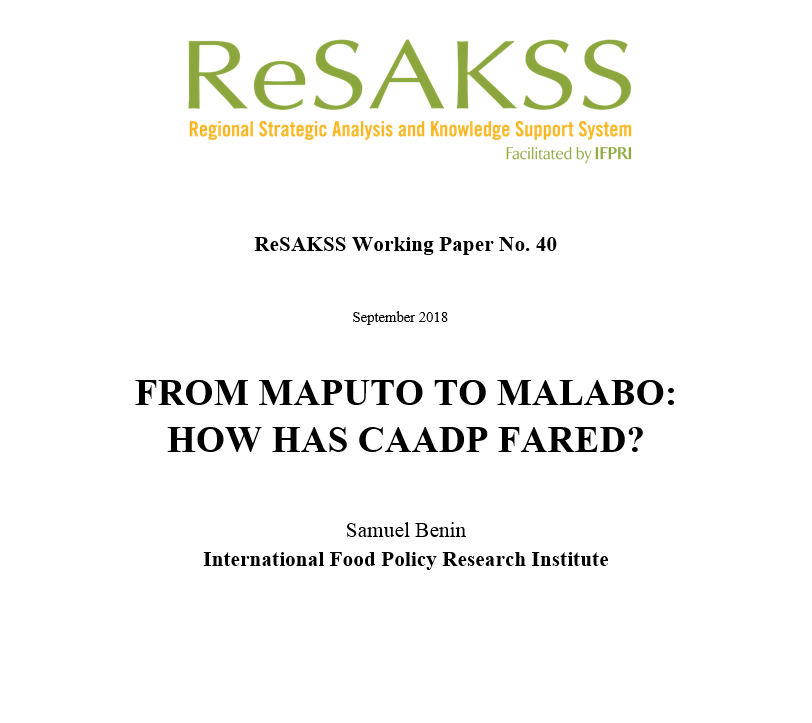
FROM MAPUTO TO MALABO: HOW HAS CAADP FARED?

PDF

AUTHOR

Samuel Benin

SERIES NAME

ReSAKSS Working Paper

YEAR

2018

ABSTRACT

This paper uses panel data on 25 African countries from 2001 to 2014 and a country and year fixed-effects model to estimate the impacts of the Comprehensive Africa Agriculture Development Programme (CAADP), an agriculture-led integrated framework of development priorities in Africa, on government agricultural expenditure, official development assistance (ODA) for agriculture, and land and labor productivity. Instrumental variables and Heckman correction (inverse mills ratio) are used to address potential endogeneity and selection bias, respectively. The results show that implementing CAADP and reaching higher stages of implementation has had significant positive impact on government agricultural expenditure, ODA for agriculture, and land and labor productivity. The impact on government agricultural expenditure wanes over time, suggesting that there is substitution effect between the government’s own funding and external sources of funding for the sector as countries advance in CAADP implementation. Implications for maintaining the positive impacts, as well as for further research, are discussed.

PUBLISHER

International Food Policy Research Institute (IFPRI)

Related Resources

  • BLOG

    Inspired by Wakanda? Creating a tempo for dynamic leadership!
    Tue, 06/19/2018

    Inspired by Wakanda? Creating a tempo for dynamic leadership!

  • BLOG

    The future of social protection in Africa
    Sat, 10/27/2018

    The future of social protection in Africa

  • PUBLICATION

    Fourth CAADP Biennial Review Brief: Tanzania

    Fourth CAADP Biennial Review Brief: Tanzania

  • EVENT

    Boosting Intra-African Agricultural Trade to Build Resilience of...
    Fri, 01/07/2022

    Boosting Intra-African Agricultural Trade to Build Resilience of...

  • PUBLICATION

    Capacity strengthening strategy through capacity needs assessment for...

    Capacity strengthening strategy through capacity needs assessment for...